Meridian Arts

Acupuncture: two maps of the invisible body

A guide to reading acupuncture meridian charts alongside modern pain, sensation, nerve, and connective-tissue explanations without pretending the maps are identical.

Map one

Meridian chart

A traditional clinical geography of points, channels, relationships, and practice language.

Map two

Sensory map

A modern body-literacy lens: nerves, sensory input, pain modulation, tissue input, and context effects.

Bridge

Useful questions

Overlap is treated as a prompt for better inquiry — not proof that the maps are identical.
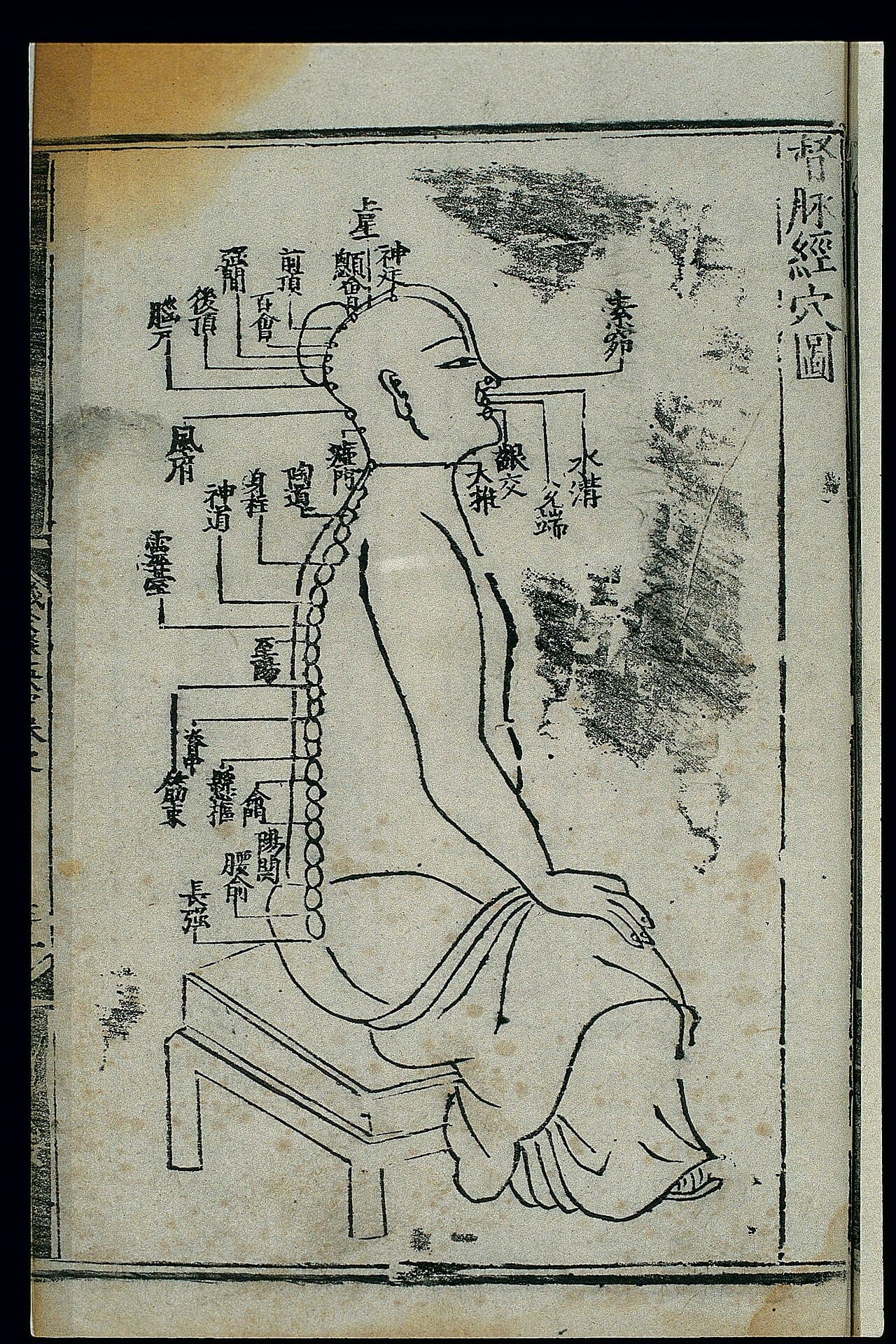
Historical Chinese acupuncture chart used on a Meridian Arts acupuncture guide, with traditional map and modern explanation kept separate in surrounding copy.

Historical chart

A historical acupuncture chart from Wellcome/Commons shows one traditional way of mapping points and channels. Read it as clinical and cultural cartography, not as proof that meridians are modern anatomical structures.

Source image: Wellcome Collection via Wikimedia Commons, Acupuncture chart, dumai (Governor Vessel), Chinese. Wellcome L0037827, licensed CC BY 4.0. Image cropped for this page.

When to be careful

This page is educational. Acupuncture should be performed by an appropriately licensed practitioner using sterile, single-use needles. Do not use it to delay urgent medical evaluation, diagnosis, or evidence-based care.

Looking at two maps

Compare the old chart with modern body explanations.

One side is a traditional clinical map of points and channels. The other is modern language about sensation, pain modulation, tissue input, attention, and context. The overlap can be useful without making the maps identical.

Map one

Meridian chart

A traditional clinical geography of points, channels, relationships, and practice language.

Map two

Sensory map

A modern body-literacy lens: nerves, sensory input, pain modulation, tissue input, and context effects.

Bridge

Useful questions

Overlap is treated as a prompt for better inquiry — not proof that the maps are identical.

Important limit: historical charts are source material; modern mechanisms are hypotheses; overlap is a question, not proof that the maps are the same.
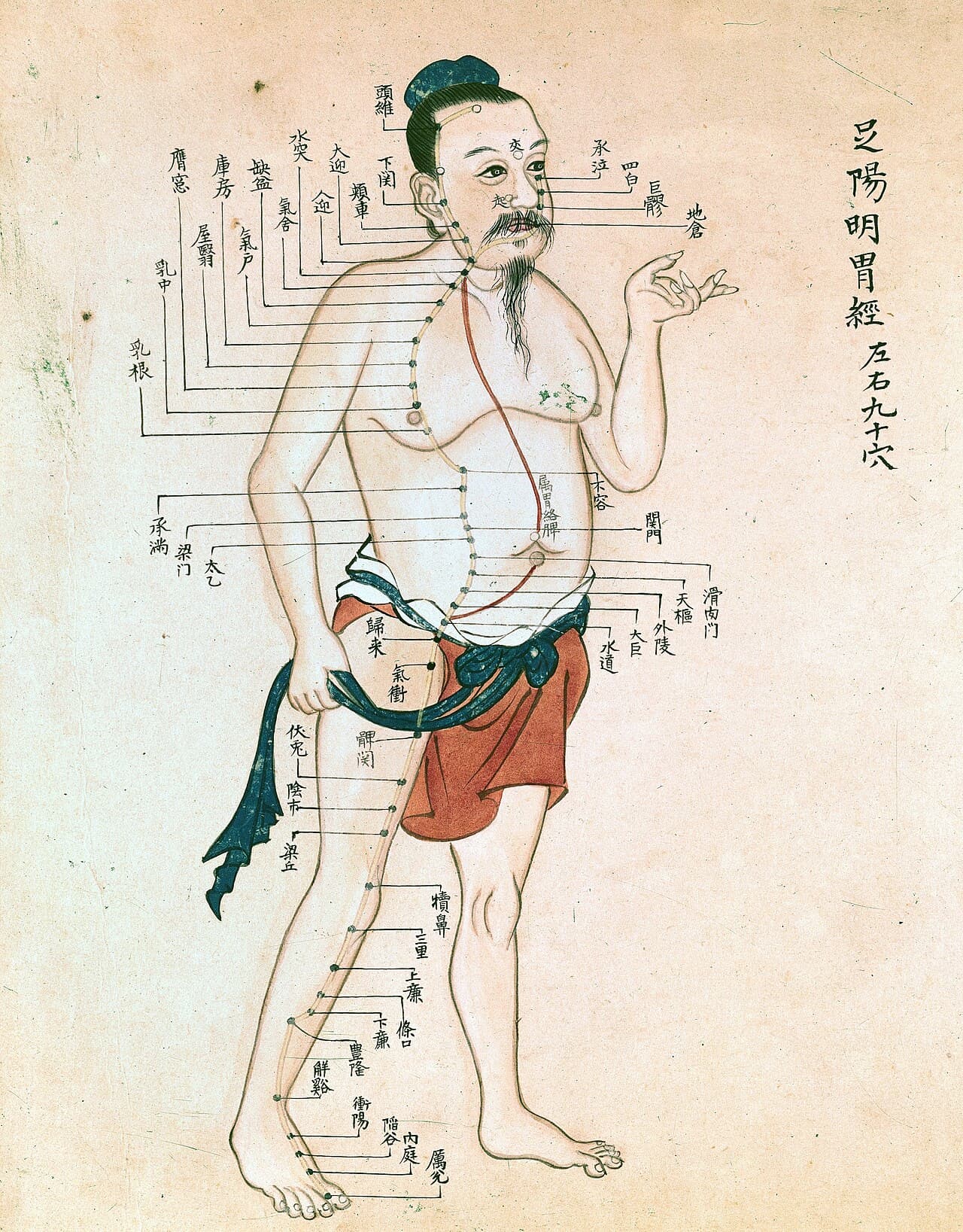
Acupuncture chart with a series of points indicated on the body. Wellcome L0012239 shown as a historical acupuncture image.
Acupuncture chart with a series of points indicated on the body. Wellcome L0012239. CC BY 4.0; shown here for historical context, not as proof.
Acupuncture chart, dumai (Governor Vessel), Chinese. Wellcome L0037827 shown as a historical acupuncture image.
Acupuncture chart, dumai (Governor Vessel), Chinese. Wellcome L0037827. CC BY 4.0; shown here for historical context, not as proof.

Short version

  • Acupuncture uses sterile, single-use needles at selected points.
  • It may help some people with pain or regulation, but mechanisms are still debated.
  • The useful body-literacy lens is sensation, attention, expectation, context, and tissue input.
  • It should not delay diagnosis or medical care.

Map one: meridians

  • Meridian charts organize points, channels, relationships, and practice language.
  • Historical charts are best read as clinical and cultural maps, not literal anatomy.

Map two: nerves and sensory modulation

  • Discuss sensory input, descending pain modulation, endogenous opioids, adenosine, autonomic shifts, local tissue effects, and sham-control difficulty with cautious language.
  • Separate evidence-backed outcomes from speculative mechanisms.

Bridge layer: fascia, interstitium, mechanosensation

  • Frame connective-tissue hypotheses as one possible part of the story.
  • Use overlap zones as prompts for inquiry, not proof of identity.

How to try it intelligently

  • Use a licensed practitioner.
  • Confirm sterile, single-use needles.
  • Pick one outcome to track.
  • Treat it as a short course that should support movement, sleep, rehab, or participation, not replace them.

Read with care

Keep the maps distinct

Meridian maps and nerve maps are different body cartographies. They overlap in suggestive places, but neither should be reduced to the other. The useful question is how humans map invisible function: sensation, pain, regulation, attention, and tissue continuity.

Helpful language

  • may help some people
  • evidence suggests
  • not fully understood
  • traditional clinical map
  • practice/literacy cartography
  • mechanistically plausible

Overclaims to watch for

  • meridians are nerves
  • meridians are fascia
  • proves ancient medicine was right
  • promises certain clinical outcomes
  • correction-certainty language
  • clinical certainty language